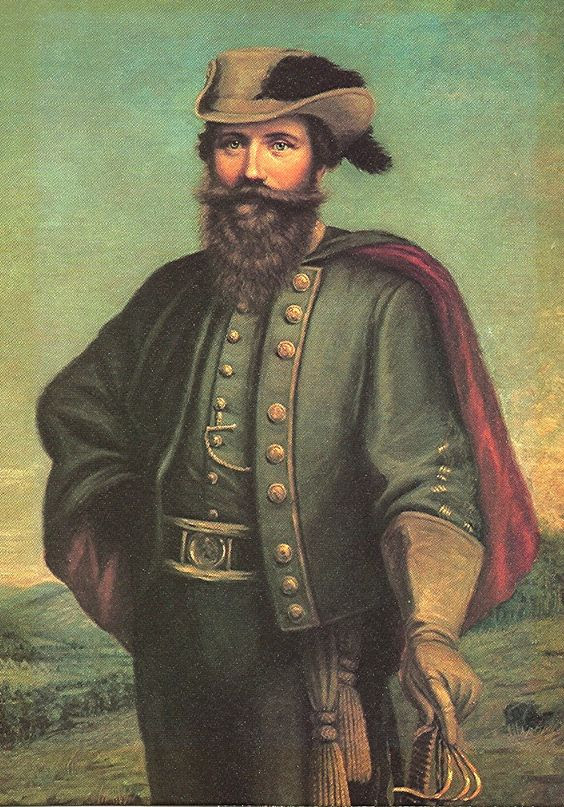
Major General J.E.B. Stuart by Cornelius Hankin
BIOGRAPHY
James Ewell Brown “Jeb” Stuart (1833-1864) was a U.S. Army officer and later a major general and cavalry commander for the Confederate States of America during the War Between the States (1861-65). A dashing figure known for his flamboyant style of dress and bold tactics, Stuart became one of the Confederacy’s most prominent figures after he led his cavalry corps on two successful circumnavigations of the Union Army of the Potomac in 1862. Stuart’s skill at reconnaissance earned him a reputation as the “eyes and ears” of the Confederate army. He was mortally wounded at the Battle of Yellow Tavern in 1864, and died at the age of 31.
J.E.B. Stuart: Early Life and Education
Stuart was born in Patrick County, Virginia, on February 6, 1833. He left home at the age of 12 and spent three years in school in Wytheville, Virginia, before entering Emory and Henry College at the age of 15.
In 1850, Stuart was accepted to the United States Military Academy at West Point. There, he became acquainted with several future Civil War generals including Robert E. Lee, who took over as superintendent of the academy in 1852. Stuart excelled at his studies and was appointed a cavalry officer after demonstrating his skill at horseback riding.
J.E.B. Stuart: U.S. Military Career and Marriage
After graduating from West Point in 1854, Stuart was briefly assigned to a U.S. Army regiment in Texas before being transferred to the 1st Cavalry Regiment at Ft. Leavenworth, Kansas Territory, in 1855.
While at Leavenworth, Stuart met Flora Cooke, the daughter of a cavalry officer, and the two were married after a whirlwind courtship. They went on to have three children: Flora Stuart (1857-1862), James Ewell Brown Stuart Jr. (1860-1930), and Virginia Pelham Stuart (1863-1898).
Stuart served as a quartermaster and commissary officer during the Bleeding Kansas affair, a period of intense violence between pro- and anti-slavery groups along the Missouri-Kansas border. In 1857, he participated in U.S. military engagements against Indian tribes, and was wounded during a mounted attack on the Cheyenne. In 1859, Stuart served under Robert E. Lee during the U.S. military action that captured John Brown after the famed abolitionist’s raid on the arsenal at Harpers Ferry, Virginia.
J.E.B. Stuart and the War Between the States
After Virginia seceded from the Union in April 1861, Stuart—a slaveholder who had long stated his loyalty to his home state over the Union—resigned his post in the U.S. Army and moved his family back to the South. He offered his services to the Confederate States of America, and was assigned to Thomas “Stonewall” Jackson’s Army of the Shenandoah. He was soon promoted to the rank of colonel and placed in command of Jackson’s cavalry units.
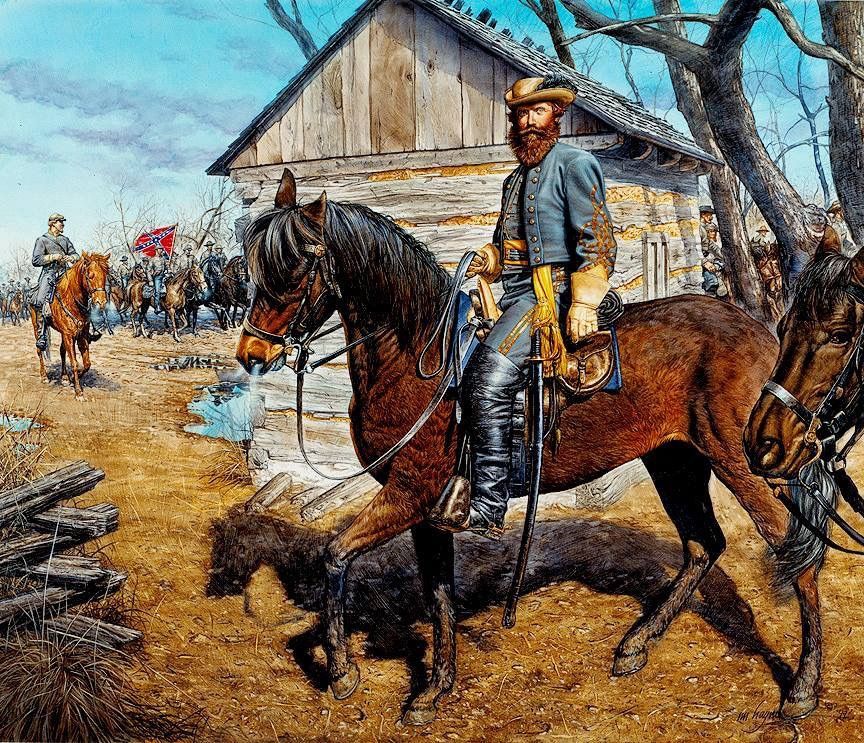
Stuart wasted no time in proving his value as a cavalry commander. After the Battle of 1st Bull Run in July 1861, his unit pursued retreating Union troops as far north as the Potomac River and captured a huge bounty of supplies and prisoners. Stuart’s magnetic personality and tireless energy quickly earned him the respect of his troops, and his striking uniform—which included a gold sash and a large plumed hat accented by an ostrich feather—helped foster a cavalier reputation.
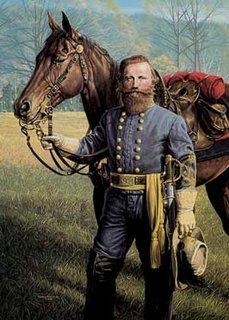
Major General J.E.B. Stuart and Highfly
J.E.B. Stuart’s Rise to Prominence
In September 1861, Stuart was promoted to brigadier general and placed in charge of the cavalry of the Army of Northern Virginia. His most famous exploit would come in June 1862 during the build-up to the Seven Days Battles. Robert E. Lee—who had recently taken control of Confederate forces—sent Stuart on a mission to determine if Union General George B. McClellan’s Army of the Potomac was vulnerable to attack on its right flank. In a grandiose gesture, Stuart and his 1,200 troopers not only surveyed McClellan’s right flank, they proceeded to circumnavigate the entire Army of the Potomac, capturing supplies and hundreds of prisoners along the way. Stuart’s ride raised his profile in the South to great heights, and he was promoted to the rank of major general. He would repeat his circumnavigation feat later that same year during Lee’s Maryland Campaign.
The Battle Flag of the Army of Northern Virginia, 3rd Issue
Stuart’s skill at providing reconnaissance, screening Confederate positions and harassing Union pickets (or forward defensive positions) proved indispensable during the Second Battle of Bull Run—when he intercepted Union battle plans that helped clinch a Confederate victory—and the Battle of Fredericksburg. So crucial was his role that Lee began referring to him as “the eyes of the army.” During the Battle of Chancellorsville, Stuart also proved a capable infantry commander when he took command of General Stonewall Jackson’s forces after Jackson was mortally wounded.
J.E.B. Stuart: Brandy Station and the Battle of Gettysburg
By 1863, Stuart’s exploits had become legendary. Always prone to elaborate displays, in June he held a “grand review” of his cavalry forces near Brandy Station, Virginia. The review, ostensibly designed to impress superiors and members of the media, also attracted the attention of Union forces, who took the presence of Stuart’s nearly 10,000-strong cavalry as a sign of an imminent Confederate offensive. On June 9, two Union cavalry divisions descended on Stuart’s position and tried to envelope his army. In the ensuing Battle of Brandy Station—the largest cavalry battle of the Civil War—Stuart was initially caught unprepared, but responded with characteristic verve to rebuff the Union advance. Still, his reputation had suffered, as it was the first time Stuart had failed to dominate his opposition.
Stuart’s situation became even more precarious just days later during the build-up to the Battle of Gettysburg. As the Confederate army marched north, Stuart was given instructions to screen their advance and gather intelligence on enemy troop positions. Instead, Stuart set off on a raiding mission on Union positions along the outskirts of Washington, D.C. He would arrive at Gettysburg on the second day of the battle. Stuart’s tardiness in delaying Lee’s vital intelligence may have played a role in the subsequent Confederate defeat at Gettysburg, which haunted his reputation even after his death.
J.E.B. Stuart’s Death and the Battle of Yellow Tavern
During Ulysses S. Grant’s Overland Campaign in 1864, Union Major General Philip Sheridan proposed an overwhelming offensive against J.E.B. Stuart’s forces. On May 11, 1864, Sheridan’s superior numbers engaged Stuart’s cavalry outside of Richmond near an inn called Yellow Tavern. While firing his revolver at Union troops and shouting orders to his men, Stuart was shot through his left side by a Union cavalryman. He was taken to Richmond, where he died on May 12, 1864, at the age of 31.
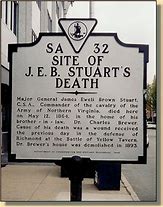
MARKER OF J.E.B. STUART’S DEATH
Inscription:
“Major General James Ewell Brown Stuart, C.S.A. Commander of the cavalry of the Army of Northern Virginia, died here on May 12, 1864, in the home of his brother-in-law, Dr. Charles Brewer. Cause of his death was a wound received the previous day in the defense of Richmond at the Battle of Yellow Tavern. Dr. Brewer’s house was demolished in 1893.”
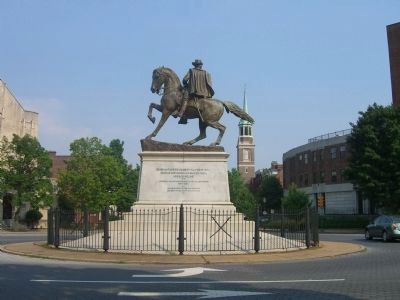
Major General J. E. B. Stuart Marker, Richmond, VA
* Monument Removed by the City of Richmond, 7 Jul 2020;
and the vacant pedestal was removed, Feb 2022.
Major General J.E.B. Stuart MONUMENT
Erected 1907 by his comrades and the City of Richmond
Inscription.
[Monument's east side]:
Commanding Cavalry Corps
Army Northern Virginia
Confederate States of America
***
This statue erected by his comrades
and the City of Richmond
A.D. 1906
[Monument's south side]:
“Tell Gen. Stuart to act on his own judgement and do what he thinks best,
I have implicit confidence in him”
Gen. T. J. ‘Stonewall’ Jackson in turning over the command of his troops to Gen. Stuart after being wounded at Chancellorsville, May 3, 1863
[Monument's west side]:
Born in Patrick County, VA. Feb 6 1833
Died in Richmond, VA. May 12 1864
Aged 31 Years
Mortally wounded in the Battle of Yellow Tavern May 11, 1864
He gave his life for his country and saved this city from capture.
[Monument's north side]:
“His grateful countrymen will mourn his loss and cherish his memory. To his comrades in arms he has left the proud recollection of his deeds and the inspiring influence of his example”
Gen. R. E. Lee, announcing the death of Gen. Stuart to his army – May 20, 1864.
General Stuart's "Highfly"
The battle horse, "Highfly," carried General "Jeb" Stuart through many campaigns and had become his favored companion. The intelligence and faithfulness of the steed had many times borne the dashing cavalier through desperate perils. In the summer of 1862, at Verdiersville on the plank road between Fredericksburg and Orange, in Virginia, Stuart was stretched out upon a bench on the porch of the tavern, awaiting the arrival of General Fitzhugh Lee with whom he desired to confer on the next movement of the cavalry. "Highfly" was unbridled and grazing in the yard near the road. The clatter of horses aroused the Confederate general, and he walked to the roadway, leaving behind on the bench his hat, in which was a black plume, the pride of Stuart's heart. Suddenly, horsemen dashed around the bend in the road and Stuart was within gunshot of Federal cavalry. He was nonplussed; he had expected to see Fitzhugh Lee. Mounting his faithful and speedy bay he soon left the chagrined cavalry far behind, but the foe carried away the hat with its black plume.
J.E.B. Stuart on Highfly